By Alan Kilpatrick
Last week, I presented a webinar on LegalTrac for the Saskatchewan Provincial Library and public librarians throughout the province. You can view the entire recorded webinar free of charge at http://librarytoolshed.ca/content/legaltrac-webinar.
 LegalTrac is an online journal article index, featuring selected full-text coverage of law reviews, journals, and newspapers from American, Canadian, and European legal sources. It is endorsed by the American Law Library Association and can be accessed through the Saskatchewan public library system. The next time you experience difficulty locating a journal article, I encourage you to search LegalTrac.
Two previous Legal Sourcery tips of the week by Ken Fox explored how to search LegalTrac effectively:
• LegalTrac & The Wheel of Topics (Tip of the Week)
• Finding Canadian Journal Articles on LegalTrac (Tip of the Week)
This webinar is a part of the Law Society of Saskatchewan Library’s ongoing efforts to advance access to justice in unique ways. My hope is that, by connecting with public librarians through this webinar, they will be able to help members of the public who are coming to the library with legal questions.
(Reposted from Legal Sourcery)
Presenter:
Alan Kilpatrick, Reference Librarian with the Law Society of Saskatchewan Library in Regina, will provide an overview of LegalTrac in this lunch-hour webinar for Saskatchewan library staff.
Topic:
LegalTrac is an authoritative journal article index, featuring selected fulltext coverage of law reviews, legal journals, publications, and newspapers from American, Canadian, and European legal sources. It is endorsed by the American Law Library Association and is available to all members of the Saskatchewan public through their public libraries. Additionally, Alan will provide an overview of the Law Society of Saskatchewan Library and the services it provides to its members and the public.
This webinar will be presented using Adobe Connect. You’ll need a computer with speakers or headphones to hear the webinar. Access details will be sent to registrants prior to the webinar.
RSVP: regan.gunningham@gov.sk.caby September 21, 2015
By Alan Kilpatrick
 Are you familiar with Flip Your Wig for Justice? Flip Your Wig for Justice is an enthusiastic new campaign promoting access to justice for low income Canadians and encouraging dialogue about the Canadian legal system. The first edition of Flip Your Wig magazine describes the intention of the campaign,
“Flip Your Wig for Justice plays on the image of the traditional barristers wig – that powered, itchy relic of another era – and the idea that lawyers are flipping our wigs in frustration over the state of access to justice in Canada. This playful campaign draws attention to the issues, without, downplaying the many hurdles that exist to creating a just legal system.”
Six non-profit organizations based in Ontario created Flip Your Wig for Justice:
• Action on Violence (METRAC)
• Association in Defence of the Wrongly Convicted (AIDWYC)
• Canadian Civil Liberties Association (CCLA)
• Community Legal Education Ontario (CLEO)
• Ontario Justice Education Network (OJEN)
• Pro Bono Students Canada (PBSC)
These organizations help disadvantaged Canadians by providing free legal help, education about the law, and encouraging lawyers to provide free legal assistance. Hundreds of lawyers, law firms, and organizations across Canada have joined the campaign to promote equitable access to justice.
Have you thought about flipping your wig for justice? Your can visit the website athttp://www.flipyourwigforjustice.ca/ to join the campaign or donate today.
Sources
Flip Your Wig for Justice. (2015). Home. Retrieved from http://www.flipyourwigforjustice.ca
Gershbain, N. & Sossin L. (2015). Lawyers Let Their Hair Down for a Good Cause. Flip Your Wig Magazine, 1(1), 2-3.
(Reposted from Legal Sourcery)
By Alan Kilpatrick
The April 24th, 2015 issue of The Lawyers Weekly highlights an important step forward for self-represented litigants in Saskatchewan. Members of the Law Society of Saskatchewan access the online edition of The Lawyer’s Weekly for free through the Members’ Section.
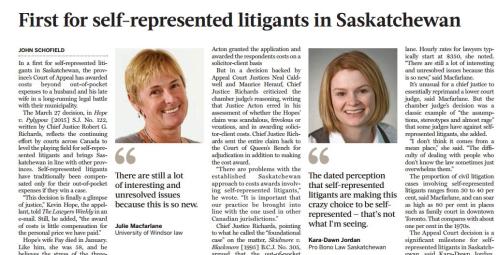
This past March, the Saskatchewan Court of Appeal awarded a self-represented litigant named Kevin Hope with costs beyond out-of-pocket expenses in Hope v Pylypow, 2015 SKCA 26. The article explains that:
The March 27 decision, in Hope v. Pylypow [2015] S.J. No. 122, written by Chief Justice Robert G. Richards, reflects the continuing effort by courts across Canada to level the playing field for self-represented litigants and brings Saskatchewan in line with other provinces. Self-represented litigants have traditionally been compensated only for their out-of-pocket expenses if they win a case.
In the written decision, the judge clarified his reasoning behind awarding costs beyond out-of-pocket expenses:
[54] …the time has come to review and update the governing principles in this area. There are problems with the established Saskatchewan approach to costs awards involving self-represented litigants. It is important that our practice be brought into line with the one used in other Canadian jurisdictions.
In the article, Kara-Dawn Jordan, the Executive Director of Pro Bono Law Saskatchewan, stated that the Appeal Court decision was a significant milestone for self-represented litigants in Saskatchewan, and expressed her satisfaction with the outcome: “I was really happy to see that they did pay some attention to the work that the self-represented litigant was doing on his own…”
Sources
CanLII. (2015, March 27). Hope v Pylypow, 2015 SKCA 26. Retrieved from http://canlii.ca/t/ggwxh.
The Lawyers Weekly. (2015, April 24). First for Self-represented Litigants in Saskatchewan. Retrieved from http://www.lawyersweekly.ca.
(Reposted from Legal Sourcery)
By Alan Kilpatrick
Lisa Ryan, reporting for Law360, recently wrote a great article encouraging law firms to turn to their librarians for help with business development: How Librarians Can Drum Up Business for Your Firm. Law librarians, Ryan explains, possess unique information-gathering skills and strong knowledge of research tools making them well suited to support a law firm’s business development activities.
You can read the full article here. It highlights three ways law librarians can help their firms:
• They Can Research Potential Clients
• They Can Spot Laterals Worth Hiring
• They Can Stay on Top of Emerging Trends
Ryan likens law librarians to “trained hunter-gatherers when it comes to getting information…” As such, librarians can discover information about potential clients and lateral hires usually overlooked by others. Monitoring research tools, librarians are able to see the emergence of new trends others have yet to become aware of.
Ryan’s article is another example of the value law librarians are bringing to the legal profession. Let us know what you think. Are librarians drumming up business for their firms?
(Reposted from Legal Sourcery)
By Alan Kilpatrick
Roly Keating, the director of the British Library, asserted in a recent Telegraph article (written by Hannah Furness) that libraries could well outlast the internet. Addressing the common perception that libraries are becoming less relevant in our increasingly digital world, Keating notes:
I was surprised, and continue to be, how many smart people ask me in all seriousness “do we really still need these library things in this age of smart phones, search engines” and so on?… When we talk about libraries, I’m told about the old values, the traditional values of these institutions. Some believe they are being replaced by new ones about being more open and connected and virtual.
As a Reference Librarian with the Law Society of Saskatchewan Library, I often encounter this inaccurate perception, questioning the continued need for our library. To battle this perception and to ensure the library remains at the forefront of relevancy, one of our goals has been to reintroduce the Saskatchewan legal community to the resources and expertise the library offers and to position the library as the central hub for legal resources in the province.
The library offers expert legal research services to members and frequent legal research instruction sessions such webinars, interactive bootcamps, and online tutorials. The library has led the campaign to digitize Saskatchewan case law this past year. We can now boast that coverage of Saskatchewan case law has increased substantially and that CanLII now features a nearly complete record of Saskatchewan case law back to 1907. The Members’ Section of the Law Society website features convenient desktop access to an impressive range of subscription databases and ebooks.
In response to the common misconception that libraries are destined for irrelevancy in the face of the internet juggernaut, Keating highlights the enduring values libraries continue to embody:
“[Libraries] stand for a certain freedom, and privacy of thought and search and expression… They stand for private study in a social space; they are safe, they’re places of sanctuary and play a vital role in some of the poorest communities. And they are trusted…The time frame we think on, centuries back and centuries into the future, allows us to think about trust in its highest sense, and authentication and provenance of information, and digital information in particular…Those are hard-won privileges and values and they’re worth defending.”
Keating aptly concludes, “With all our fascination of and love for the internet in the age of data, these values and the values and idea of the library predated the internet and if we get it right may yet outlast it.”
You can read the full article here: http://www.telegraph.co.uk/culture/hay-festival/11627276/Libraries-could-outlast-the-internet-head-of-British-Library-says.html
Will libraries outlast the internet? Yes, I believe they will. Let us know what you think.
(Reposted from Legal Sourcery)
By Alan Kilpatrick
Shaunna Mireau, the Director of Knowledge Management and Process Improvement at Field Law in Edmonton and a prominent member of the Canadian Association of Law Libraries (CALL), recently wrote a blog post about Librarian Visibility on Slaw that resonated with me.
In the post, Mireau notes that recent events have inspired her to think more about the visibility and value of law librarians. Some of these include her upcoming attendance at the Canadian Bar Association Conference (CBA) on behalf of CALL and the upcoming Edmonton Law Libraries Association HeadStart program, a successful legal research program pioneered by law librarians.
Mireau explains the core reason behind these events is to make law librarians more visible and to highlight the value law librarians bring to the table. Reflecting on my experiences in this profession, I realize many activities I am involved in are intrinsically connected to raising the visibility and advocating the value of law librarians as well.
Our chief intention behind Legal Sourcery, the Law Society of Saskatchewan Library’s popular blog, was to make the library more visible among the Saskatchewan legal community and to encourage our members to reconceptualise the library as more than bricks and mortar. Our increasingly frequent forays into legal research instruction, the half-day Legal Research Bootcamp, webinar series, and ongoing CPLED presentations, were intended to promote our expertise and to let members know the library is here to help whenever they require it. Finally, the library’s decision to host a library booth at the CBA Saskatchewan’s Mid-Winter Meeting for the first time in several years was made to raise the profile of the library.
Mireau continues by questioning why she takes the perception others have of law librarians so personally. I must admit that I also take the perception others hold of law librarians personally. The draconian cuts to federal libraries over the past few years are certainly reason enough to give any law librarian pause – I was privileged to work as a Reference Librarian (co-op) with the Transport Canada Library shortly before it was shut down.
Should we connect this to the status anxiety that many librarians are said to have about whether librarianship is a true profession like law or medicine? Andrew Abbot describes this common sentiment in his article, Professionalism and the Future of Librarianship:
“Even today, every time people use the word “professionalization,” the image they have in mind is an escalator steadily bearing themselves and their occupations toward a higher status. When they arrive, the would-be professionals think people will respect them and their judgment. But the escalator on which librarians are perched has somehow never arrived. After a century, librarianship seems no nearer to its goal than in the Dewey days.”
However, many have thrown out this long held status fixation suggesting that a preoccupation with status actually has the potential to hinder what librarians do best – helping connect clients with the information they need. Why do we take the perception others hold of us and our profession so personally? Is it because many of us entered the library profession with a strong desire to help people?
References
Abbott, Andrew. “Professionalism and the Future of Librarianship.” Library Trends 46.3 (1998): 430-444. Web. 24 June 2015.
Birdsall, William F. “Librarians and Professionalism: Status Measured by Outmoded Models.” Canadian Library Journal 37 (1980): 145-148. Print
(Reposted from Legal Sourcery)
By Alan Kilpatrick
Several months ago, I wrote a post on Legal Sourcery about Canadian astronaut Chris Hadfield’s popular rendition of Space Oddity. Hadfield, who recorded the video while in orbit and in command of the International Space Station, posted the video on to YouTube in May 2013. The video, which was widely shared and viewed around the globe, was suddenly taken down a year later.
The video’s removal from YouTube sparked confusion and frustration. A passionate discussion about copyright law arose and many questioned why the viral hit had been removed so suddenly. The Economist and The Globe and Mail both reported on the intricate framework of copyright law aboard the International Space Station.
To the relief of many fans, Hadfield’s video was reposted to YouTube late last year. What exactly happened? Hadfield explains the situation on his website,
“…it was with some regret that we took the Space Oddity video off YouTube last May. David Bowie and his publisher had been very gracious. They had allowed his work, his intellectual property, to be made freely available to everyone for a year, and had in fact worked with us and the Canadian Space Agency to make it happen. There was no rancour, and we removed it from YouTube to honour that agreement.”
Once the video was taken down in May 2014, Hadfield and the Canadian Space Agency began the process to obtain permission to repost the video. Hadfield explains further,
“Bowie himself loved it, posting on Facebook that it was possibly the most poignant version of the song ever created. As a result of this, the recent reapplication of the legal process has been fairly straightforward.”
You can watch the video here.
Source
Hadfield, Chris. (2015). Space Oddity. ChrisHadfield.ca. Retrieved from: http://chrishadfield.ca/space-oddity/
(Reposted from Legal Sourcery)
By Alan Kilpatrick
The National Self-Represented Litigants Project (NSRLP) has recently developed an amazing new resource for self-represented litigants (SRLs) called, The CanLII Primer. Are you familiar with the NSRLP? The NSRLP is a research group, created by Julie Macfarlane, which promotes access to justice and legal resources for SRLs. Macfarlane, a professor in the Faculty of Law at the University of Windsor, has extensively researched access to justice issues in Canada. You can learn more at about the NSRLP at the Project’s website.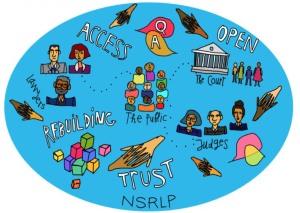
The CanLII Primer was created to help SRLs search CanLII for case law and legislation. It was developed by NSRLP’s Research Assistant Tamara Thomas. Thomas describes why she was motivated to create the primer on the NSRLP website,
“The CanLII Primer aims to help SRLs develop a basic understanding of how to operate CanLII in a straightforward and effective way. CanLII is a wonderful resource because it is open to anyone to use – no fees, no commitments – but it can also be frustrating to operate.”
The primer begins by describing the Canadian legal system, the structure of the Canadian Courts, and the system of precedents. Through simple search examples, the primer explains how to construct basic keyword searches, locate case law and legislation, and how to use CanLII to sort search results. The primer concludes by offering a basic research strategy. It suggests SRLs begin with legislation and then proceed to case law, while keeping the precedent system in mind. Additionally, the primer features a helpful glossary of legal terms.
Thomas explains the most challenging aspect of creating a primer for individuals without a legal background,
“The legal system is one created by and dependent upon inaccessible and unintuitive language, and trying to access and understand the legal research process without properly understanding that language throws up yet another barrier to SRLs. Writing the Primer required that I completely deconstruct everything that I knew in a way that we are not taught in law school. ”How do I explain this in a way someone without a legal education can understand?’ ‘What does this term mean in everyday language?…”
The CanLII Primer is an extremely impressive resource for SRLs as it greatly improves access to justice. I look forward to seeing additional resources from the NSRLP in the future. You can access The CanLII Primer at the National Self-Represented Litigants Project website.
(Reposted from Legal Sourcery)

By Alan Kilpatrick
The 2015 Saskatchewan Library Association (SLA) Conference was held in Regina from May 7th to May 9th. The Law Society Library’s Reference Librarian, Alan Kilpatrick, presented a Spotlight On talk about the library blog, Legal Sourcery. The talk explored how Legal Sourcery has enabled the library to engage its users and shape an exciting new brand for the library.
You can read a transcript of Alan’s talk here.
(Reposted from Legal Sourcery)

 LibraryCanuck