By Alan Kilpatrick
The Saskatchewan Access to Legal Information Initiative (SALI) helps legal information providers connect the public with legal information, legal assistance options, and community support. Stay informed with our newsletter.
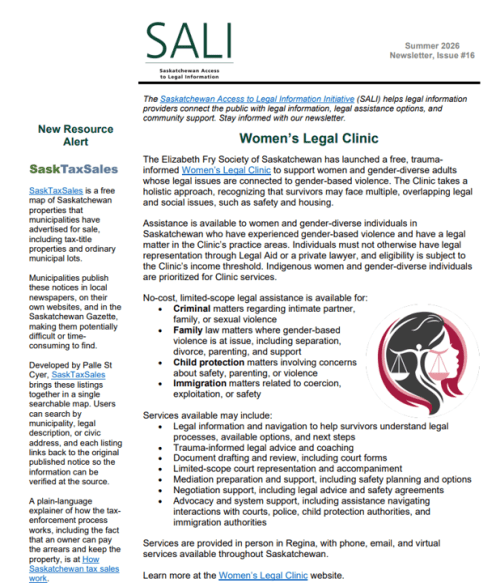
SALI’s Summer 2026 newsletter highlights:
Saskatchewan’s New Women’s Legal Clinic: The Elizabeth Fry Society of Saskatchewan has launched a free, trauma-informed Women’s Legal Clinic to support women and gender-diverse adults whose legal issues are connected to gender-based violence.
Saskatchewan’s New Black Legal Clinic: The Black Legal Clinic, created by the Truly Alive Youth and Family Foundation Inc, provides free community-centred legal support and resources, intending to make legal services more accessible, welcoming, and culturally responsive for Black individuals and families in Saskatchewan.
Two new resources: New resources addressing artificial intelligence use in court and tax sales in Saskatchewan municipalities are available.
Share our newsletter with your staff, colleagues, and teams or encourage them to sign up directly. To learn more about SALI, please visit our webpage.
By Alan Kilpatrick
In today’s legal needs and information-seeking environment, members of the public with legal problems are turning to the internet and GenAI (generative artificial intelligence) tools for information and answers, and GenAI is making it harder to distinguish credible legal information from misinformation.
Legal information professionals and law librarians are well-positioned to connect the public with credible sources of legal information and to teach the public how to research the law using reputable resources and tools. The key challenge in teaching the public to research the law is ensuring that a basic understanding of core legal concepts and research methodology is established before introducing the legal research tool itself. In practice, this requires setting aside our assumptions about legal research and what we think people should know and intentionally translating everything for an audience with little or no prior knowledge of the law and legal system.
On May 26, 2026, I spoke about this topic in Teaching Legal Research to Diverse Audiences: Practical Strategies and Sustainable Approaches, a panel I presented with Brenda Alm (Manager, Partnerships and Content, CanLII) and Jennifer Walker (Head Librarian, County of Carleton Law Association) at the 2026 Canadian Association of Law Libraries (CALL/ACBD) Conference:
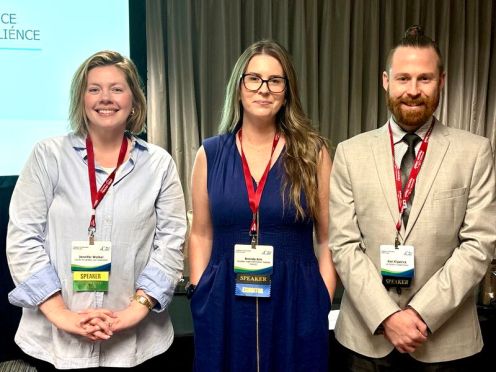
Free legal research resources play an increasingly important role across the legal information landscape. Self-represented litigants rely on them exclusively, small firms balance costs against research needs, and organizations of all sizes reassess their subscription models. This creates new teaching challenges for legal information professionals serving diverse user populations. This panel brings together practitioners from law society, law association, and open-access contexts to explore practical teaching strategies using CanLII as a common framework for discussion.
Access to legal information is a consistently identified public need, and in Saskatchewan, 40% of individuals experiencing a legal problem report searching the internet for legal information. Legal information builds awareness of legal rights and responsibilities, provides options for assistance, and may prompt individuals to resolve their legal issues or seek advice from a legal professional. These findings show that increased access to legal services and justice depends on public access to credible legal information sources, public awareness of legal assistance and advice options, and, perhaps, the public’s ability to navigate the law and conduct their own legal research.
Whether using CanLII or evaluating information generated by GenAI, effective public legal information use/research begins with a foundation in core legal concepts and research methodology. Foundation first. Tools second.
By Alan Kilpatrick
Information literacy principles remain constant, even as technology changes. As more members of the public turn to GenAI tools for answers to legal questions, information professionals and law libraries can play a critical role in helping people use these tools more safely by building GenAI information literacy among the public. This includes explaining how GenAI works, the markers of credible legal information regardless of source, tool, or technology, the risks of relying on GenAI outputs, effective prompting skills, where to find credible sources of legal information, and options for legal assistance.
On April 15, 2026, I spoke about this topic in Helping Self-Represented Litigants Navigate AI for Legal Uses, a webinar I presented with Jennifer Leitch and Annette Demers for the Canadian Association of Law Libraries (CALL/ACBD) Professional Development Committee:
Self-represented litigants (SRL) are increasingly relying on AI to aid them in preparation of court documents. Law librarians are well-positioned to advise SRL on appropriate and inappropriate uses of AI. In this session, you’ll hear more about how SRL are being warned by the courts for submitting hallucinated cases. Learn more about the vulnerabilities of SRL and sources for assistance for them. Learn about how law librarians are helping SRL navigate the pitfalls of AI, as well as practical tips and advice that law librarians can provide.
My portion of the webinar highlighted a new resource from the Saskatchewan Access to Legal Information initiative called Using GenAI Tools to Obtain Legal Information. Recognizing the reality that public use of GenAI is increasing, SALI developed the guide, rooted in strong information literacy practices, to support the informed use of GenAI tools.
The recorded webinar is available for purchase and viewing from the CALL/ACBD website, and the Using GenAI Tools to Obtain Legal Information guide is available on the SALI website.
By Alan Kilpatrick
The Saskatchewan Access to Legal Information Initiative (SALI) helps legal information providers connect the public with legal information, legal assistance options, and community support. Stay informed with our newsletter.
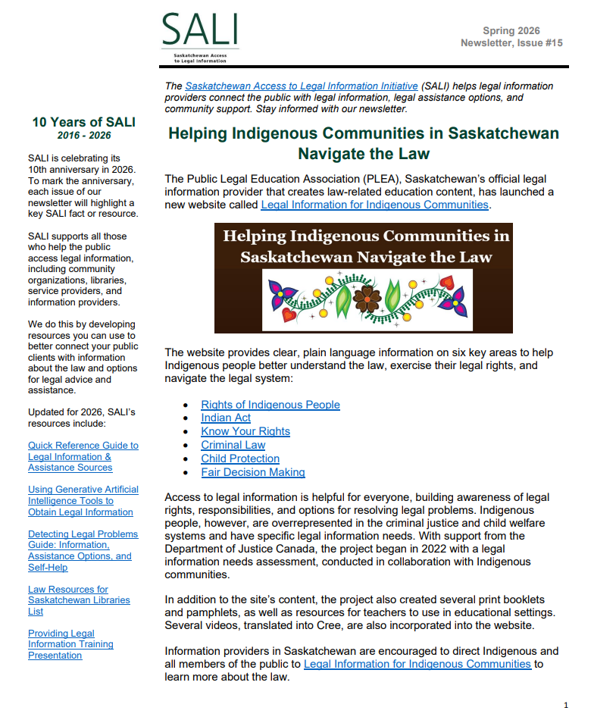
SALI’s Spring 2026 newsletter highlights:
Helping Indigenous Communities Navigate the Law:
The Public Legal Education Association, Saskatchewan’s official legal information provider, has launched a new website.
Law Update:
Every year, Saskatchewan’s Legislative Assembly passes new laws and updates existing ones, shaping everyday life. Where do you find out what changed?
Legal Information for Indigenous People:
This popular resource is available for free online as an eBook and can be ordered at no cost in print.
Share our newsletter with your staff, colleagues, and teams or encourage them to sign up directly at this link. To learn more about SALI, please visit our webpage.
By Alan Kilpatrick
On Tuesday, May 26, 2026, I am co-presenting a session at the 2026 Canadian Association of Law Libraries Conference with Brenda Alm (Manager, Partnerships and Content, CanLII) and Jennifer Walker (Head librarian, County of Carleton Law Association):
Teaching Legal Research to Diverse Audiences: Practical Strategies and Sustainable Approaches
1:15 pm – 2:30 pm
Ballroom AB, Delta Beausejour Moncton
Free legal research resources play an increasingly important role across the legal information landscape. Self-represented litigants rely on them exclusively, small firms balance costs against research needs, and organizations of all sizes reassess their subscription models. This creates new teaching challenges for legal information professionals serving diverse user populations.

This panel brings together practitioners from law society, law association, and open-access contexts to explore practical teaching strategies using CanLII as a common framework for discussion. The session uses three real-world teaching scenarios as discussion prompts, allowing panelists to demonstrate how different institutional contexts and user populations shape their instructional approaches.
We’ll address key challenges such as adapting instruction for audiences with vastly different research backgrounds and needs, creating reusable teaching materials that scale across contexts while remaining accessible, and navigating common teaching tensions like comprehensive versus focused instruction and synchronous versus asynchronous delivery.
Panelists will share practical strategies for addressing misconceptions users encounter, building sustainable teaching programs with limited time, and helping users develop critical research skills. Because CanLII is widely used across all our contexts, it serves as the practical example for exploring these broader teaching challenges. Attendees will leave with adaptable strategies and frameworks applicable to their own teaching contexts.
By Alan Kilpatrick
Saskatchewan residents can now register for temporary, free access to a digital library of legal eBooks and databases through the Saskatchewan Premium Legal Resources Portal. Resources include:

• vLex Canada – Hundreds of eBooks on family, criminal, and civil law
• rangefindr – Sentencing ranges for criminal and drug offences
• Saskatchewan King’s Bench Rules Annotated – Court rules, procedure, and commentary eBook
Accounts are active for two weeks from the registration date. Users may renew up to three times per calendar year. Who will benefit most from these resources? These are especially valuable for self-represented litigants and serious legal researchers seeking to go beyond plain-language legal information. These eBooks and databases provide in-depth legal commentary and analysis, ideal for those seeking a more comprehensive understanding of the law. Please note that access is intended for personal use only, not for professional legal work. Access must adhere to the terms of use.
Do not hesitate to get in touch with the Law Society of Saskatchewan Legal Resources Library with any questions!
By Alan Kilpatrick
There will now be a new way to get legal help in Saskatchewan because of an
initiative by the Ministry of Justice and Law Society of Saskatchewan to expand
access to legal services in underserved areas and provide the public with more
options. Recent changes to the law have created a new category of legal
professional in Saskatchewan, alongside lawyers, called limited licensees.
Limited licensees are not lawyers but are authorized to provide specific legal
services based on their education, training, and experience. Depending on their
licence, limited licensees can provide advice and negotiate with respect to legal
rights and responsibilities, draft or complete legal documents, or represent an
entity or person at an administrative tribunal or Provincial Court.
The overall goal of limited licensing is to enhance access to legal services for
underserved Saskatchewan individuals, balanced with ensuring public protection.
These legislative changes mean an increase in access to regulated legal service
providers, recognizing different types of expertise and qualifications.
Read more about this new category of licensed legal professional. The first
limited licensees will start offering legal services from January 1, 2026. Members
of the public can locate a licensed legal professional by searching the Law
Society of Saskatchewan’s Find Legal Assistance directory.
By Alan Kilpatrick
In support of 2025 Saskatchewan Access to Justice Week, the Saskatchewan Access to Legal Information Initiative created an Accessing Legal Information in Saskatchewan Infographic highlighting how people in Saskatchewan access and obtain legal information.
People rely on access to legal information to access justice. Legal Information is general information about the law. Legal information can help people learn about the law, their legal problems, ways of resolving legal problems, and legal rights and responsibilities.

By Alan Kilpatrick
The Saskatoon and Regina public libraries are hosting free Law Fairs The Saskatoon and in conjunction with Saskatchewan Access to Justice Week (Oct 27-31, 2025) to help people learn about their legal rights/responsibilities and connect with legal information and support. Save the date and spread the word!
Saskatoon Public Library, Frances Morrison Central Library
Thursday, October 23, 2025 | 1:00 – 6:00 PM
Regina Public Library, Central Adult Library
Saturday, November 1, 2025 | 12:00 – 5:00 PM
Attendees can expect:
Presentations: Legal experts discussing common legal topics
Help Sessions: One-on-one support from lawyers on family law and wills and estates
Tradeshows: Local and provincial organizations sharing legal resources and services
The Law Fairs are free and open to everyone!
By Alan Kilpatrick
Check out the latest issue of the SALI newsletter
The Saskatchewan Access to Legal Information Initiative (SALI) helps legal information providers connect the public with legal information, legal assistance options, and community support. Stay informed with our newsletter.
SALI’s Fall 2025 newsletter issue highlights:
Access to Justice Week: Attend free events that engage communities in conversations about justice.
New Options for Legal Assistance: Read about a new category of legal professional in Saskatchewan.
Access Legal Information Infographic: Learn how people in Saskatchewan access legal information.
Updated Family Law Handbook: Order free copies of the updated Family Law Handbook.
Share our newsletter with your staff, colleagues, and teams or encourage them to sign up directly link. To learn more about SALI, please visit our webpage.


