By Alan Kilpatrick
“Censorship is to art as lynching is to justice.” Henry Louis Gates Jr.
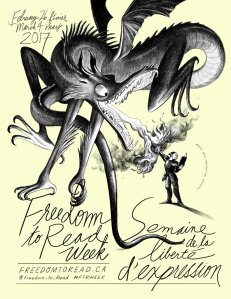 Freedom to Read Week is a yearly event dedicated to promoting intellectual freedom and the freedom to read. According to the event’s official website, it “encourages Canadians to think about and reaffirm their commitment to intellectual freedom, which is guaranteed them under the Charter of Rights and Freedoms.” This year, Freedom to Read Week is being celebrated from February 26th to March 4th.
As a staunch member of the library community, the Law Society Library is always excited to celebrate this week. We forthrightly call on all members of the Law Society to mark this occasion and stand with the library community to promote intellectual freedom. Be sure to check out www.freedomtoread.ca to find out how!
By Alan Kilpatrick
Did you catch Andrew Arruda’s TED Talk? TED Talks brings together diverse speakers to discuss exciting and emerging issues in the world today.
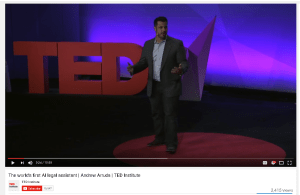 Arruda (JD’14) is a recent University of Saskatchewan College of Law graduate. In his talk, Arruda speaks about the potential of an artificially intelligent (AI) lawyer to democratize the law, reduce legal costs, and to make the practice of law cheaper for all. To accomplish this goal, Arruda worked with a computer scientist to create ROSS, the world’s first AI lawyer. I encourage you to watch the video yourself.
The primary argument Arruda makes is that an AI lawyer can help reduce legal research time and consequently lower the fees incurred as a result of legal research. Time spent on legal research, Arruda explains, is the biggest barrier to hiring a lawyer. Lawyers spend twenty or thirty hours on legal research and spend hundreds of dollars each month to access legal databases. ROSS will allow lawyers to get away from legal research.
While I am skeptical an AI lawyer can actually do what Arruda claims, the idea is intriguing. At the Law Society Library, we are continually on the lookout for the latest legal resource technology for our members. Our goal at the Law Society Library is to provide members with the newest digital resources anywhere in the province. Today you can access WestlawNext through the Members’ Section right on your computer’s desktop. Tomorrow, will you be able to access an AI lawyer?
By Alan Kilpatrick
The Law Society Library team has created a series of helpful tutorial videos to aid members in searching CanLII and the Saskatchewan Case Search. You can watch the videos by clicking on the “Library Tutorials” button on the left side of the Law Society Library homepage or by following the links below.
The short digestible videos demonstrate how to search each resource in key ways:
|
|
The Law Society library will continue to develop new tutorial videos for other online resources. Please let us know what you think about these videos and if you have any suggestions.
If you have any questions, ask a Law Society Librarian! We are pleased to provide high-quality legal research services to Saskatchewan members in person, on the telephone, or by email.
By Alan Kilpatrick
 Each month, the University of Saskatchewan’s Native Law Centre blog features a Case Watch. The Case Watch is a newsletter of digested aboriginal case law. It covers all aspects of aboriginal case law including title, rights and Gladue factors. It is a collaboration of the Native Law Centre and Pro Bono Students Canada – University of Saskatchewan Chapter.
If you are a practitioner of aboriginal law or you closely follow this area of law, I strongly encourage you to check out Case Watch!
If you have any additional questions, ask a Law Society Librarian! We are pleased to provide high-quality legal research services to Saskatchewan members in person, on the telephone, or by email.
I created a a list of the notable tasks I accomplished as a librarian in 2016:
Saskatchewan Court of Appeal Sentencing Digest Tutorial Videos (January 2016)
I am creating a series of tutorial videos demonstrating the Saskatchewan Court of Appeal Sentencing Digest. This is one of the library’s most popular databases. You can find the draft videos online here.
Lunch & Learn Sessions (March 2016)
I developed a new instruction format for the Law Society Library in 2016. Lunch & Learn sessions provide legal research training tailored to lawyer’s specific needs. Phil Gallet, a partner at McDougall Gauley, provided this feedback after the first session: “There were 27 attendees…Alan, you did an excellent job. Your power point was great and you were well prepared. A number of people – even those much more technically capable than me – remarked that they learned new things.”
Regina Public Library Legal Resources Fair (April 2016)
I facilitated the library’s involvement in the Regina Public Library’s Legal Resources Fair. At the fair, I presented a one-hour session on CanLII and Basic Legal Research Skills for the Public. The session was well attended by the public.
LegalTrac Webinar Announcement (April 2016)
In April, the Saskatchewan Provincial Library announced that my LegalTrac webinar was one of the most visited pages in the Library Toolshed in Spring 2016.
Saskatchewan Library Association Conference Session (May 2016)
I presented a session on Legal Resources for Public Libraries at SLA 2016. The session was attended by public, university, and special librarians. During the session, I gathered survey feedback for Brea Lowenberger, Access to Justice Coordinator at the University of Saskatchewan. The feedback encouraged her to proceed with a province wide access to justice project.
Canadian Association of Law Libraries Conference Lightening Talk (May 2016)
I presented a lightening talk at the 2016 CALL conference describing my role as the association’s social media coordinator.
Research Question for Pro Bono Law Saskatchewan (June 2016)
I completed a complex legal research question for Kara-Dawn Jordan in June 2016. On completion of the research, Kara-Dawn wrote: “Exactly what I was looking for Alan. You saved me a lot of time. Thank you!”
Increased Board and Committee Responsibilities (June 2016)
I have agreed to represent the Law Society Library as a Member-at-Large on the Saskatchewan Library Association Board and as a member of the CALL Vendor Liaison Committee.
Legal Resources for Librarians Webinar (October 2016)
I was asked to present an access to justice themed webinar for librarians across Canada by the Education Institute, a continuing education initiative developed by The Partnership of Provincial and Territorial Library Associations of Canada. My hope is that by connecting with public librarians, they will be able to better assist members of the public coming to the library with legal questions.
Instruction Sessions in 2016
I presented fourteen instruction sessions in 2016, double the amount of instruction sessions presented in 2015.
By Alan Kilpatrick
A re you searching for a legal themed book to read this holiday season? Why not try something from Charles Dickens? While A Christmas Carol is the most popular of Dickens’ works this time of year, lawyers, courts, and judges appear in many of his other works.
In his youth, Dickens worked as a court reporter for the English Courts of Chancery. Interestingly, you can find original copies of the Court of Chancery Law Reports from the 1800s in the Law Society of Saskatchewan Library.
Witnessing corruption and cruelty, Dickens developed a critical view of the English legal system. Many of his books reflect this and feature criticism of the courts. His experience as a court reporter greatly influenced the bleak courtroom scenes in David Copperfield.
Here are two notable Dicken’s quotes about the law:
From Bleakhouse:
“The one great principle of the English law is to make business for itself. There is no other principle distinctly, certainly, and consistently maintained through all its narrow turnings. Viewed by this light it becomes a coherent scheme and not the monstrous maze the laity are apt to think it. Let them but once clearly perceive that its grand principle is to make business for itself at their expense, and surely they will cease to grumble.”
 From A Tale of Two Cities:
“It is the law,” remarked the ancient clerk, turning his surprised spectacles upon him. “It is the law.”
“It’s hard in the law to spile a man, I think. It’s hard enough to kill him, but it’s wery hard to spile him, sir.”
“Not at all,” retained the ancient clerk. “Speak well of the law. Take care of your chest and voice, my good friend, and leave the law to take care of itself. I give you that advice.”
By Alan Kilpatrick
Researching employment law? You will be excited to learn about a new employment law resource, bardalfactors.ca. Designed to be used by lawyers and self-represented litigants, this tool enables you to quickly and easily identify reasonable notice periods for termination and dismissal.
Specifically, the tool allows you to locate cases that have applied the Bardal factors. What are these factors exactly? The factors come from the 1960 decision Bardal v. Globe & Mail Ltd. (1960), 24 DLR (2d) 140. They include age, length of employment, character of employment, and availability of similar employment. According to the website, the factors:
Represent the starting point in determining reasonable notice. And since there are over 1,000 rulings from Canadian courts expressly laying out precisely how the factors were applied, everyone – from employment lawyers to employers to employees – can look through the rulings and form a pretty good guess of how a court might rule.
However, bardalfactors.ca cautions that employment law is very complex and the factors are only a basic starting point for determining legal entitlement to notice. More research is always needed. The tool is still under development and is available in beta.
Employment lawyers, please let us know what you think about this new website! Check out this YouTube video if you would like practical tips on searching it.
By Alan Kilpatrick
In exciting news, Maritime Law Book (MLB), a stalwart of the Canadian legal publishing industry for the past 40 years and creator of the popular national reporter system, was purchased by Colin Lachance on November 1st. This is good news for those who were mourning the demise of MLB, previously reported by Slaw last August.
Lachance is well known in Canada as the former CEO of CanLII and a legal entrepreneur. He was recognized as a Fastcase50 Legal Innovator in 2013, American Bar Association Legal Rebel in 2014, and among the 25 most influential Canadian lawyers in 2014 by Canadian Lawyer magazine.
Purchasing a case law publisher in today’s economic climate is a bold move. However, Lachance’s involvement with MLB will surely lead to some exciting advancements for Canadian legal researchers:
“The pace of technological advancement is accelerating, and we want to bring the benefits of that advancement to legal researchers,” says Colin Lachance. “In addition to smarter search, we will provide high demand tools like visualizations that allow you to more quickly zero in on the cases you need, and we will deliver personalized research trails that help you train our system to learn what’s important to you.”
The development is also sure to shake up Canada’s staid legal publishing industry, a near duopoly. You can learn more about the purchase from the MLB press release.
By Alan Kilpatrick
Remember Y2K, the crisis that prompted people to take up survivalism, stockpile rations in the woods, and predict the end? Fortunately, the Law Society Library was prepared for the worst. Y2K preparations made by the Law Society Library were detailed in a June 1999 Benchers’ Digest article entitled, Year 2000 Computer Compliance.
First, exactly what was Y2K? The article explains,
What is everyone talking about “Y2K” and what does this mean for your law firm? The year 2000 compliance problem is related to the turn of the century, when we change from the 1900’s to the 2000’s. Computer programmers many years ago used two digits to indicate a year in their computer programing….This could pose a problem when January 1, 2000 clicks over on the computer.
What exactly was the Law Society Library doing to prepare for the impending disaster? The Law Society had a plan,
There are no guarantees of exactly what will happen on January 1, 2000….The Law Society Library developed a plan after conducting research on what issues existed and looked for ideas on what we need to do to make sure our system is less likely to fail for our users on January 1, 2000.
The plan involved creating a detailed inventory of hardware, testing all software, accessing all data files using two digit years, conducting a full backup of the entire system before December 31, and “developing a contingency plan to help the library deal with issues in case something goes wrong on January 1, 2000…”
Ignoring the Y2K problem will not make it go away. There is still time to act…before December 31, 1999….The tests and contingency plans are your best efforts to minimize the impact and possible damages before entering the new century.
While the Y2K furor may seem somewhat humorous in retrospect, I hear that we are coming up on the Year 2038 problem (Y2038) next.
References
Benchers’ Digest (June 1999): Baer, Susan. Year 2000 Computer Compliance. 8-10. Print.
By Alan Kilpatrick
Need to research foreign, comparative, or international law (FCIL) and are not sure where to begin? I encourage you to check out GlobaLex, an outstanding source of free high-quality FCIL articles and research tools. You can access GlobaLex online at http://www.nyulawglobal.org/globalex.
GlobaLex, maintained by the Hauser Global Law School Program at NYU LAW, was launched in 2005 by Mirela Roznovschi. Roznovschi, who recently retired from her successful career as a Foreign and International Law Reference Librarian, is a well-known authority in the FCIL research field. In addition to GlobaLex, she helped create the American Association of Law Libraries FCIL special interest section.
GlobaLex is dedicated to providing the legal profession and the public across the globe with free access to authoritative FCIL research. For example, it provides research guides for over 150 nations. About GlobaLex describes the scholarly nature of the information it disseminates:
The information and articles published by GlobaLex represent both research and teaching resources used by legal academics, practitioners and other specialists around the world who are active either in foreign, international, and comparative law research or those focusing on their own domestic law. The guides and articles published are written by scholars well known in their respective fields and are recommended as a legal resource by universities, library schools, and legal training courses.
GlobaLex contains four different sections: International Law Research, Comparative Law Research, Foreign Law Research, and Tools for Building FCIL Collections. You can navigate each section by selecting the section heading. Resources in each section are listed alphabetically.
• International Law Research provides a variety of articles discussing international treaties, agreements, and other topics of international importance
• Comparative Law Research provides several articles discussing differences and similarities between various legal system
• Foreign Law Research provides legal research guides for over 150 countries from Afghanistan to Zimbabwe
• Tools for Building FCIL Collections provides advice for librarians developing FCIL library collections
GlobaLex is an ideal starting point for lawyers conducting FCIL research. Please comment below if you are familiar with any other free FCIL resources.
Sources
American Association of Law Libraries. (2007). Guides for the World: GlobaLex. Retrieved from http://www.aallnet.org/mm/Publications/spectrum/Archives/Vol-11/pub_sp0706/pub-sp0706-guides.pdf
Hauser Global Law School Program. (2015). GlobaLex. Retrieved from http://www.nyulawglobal.org/globalex/
New York University Law. (2013). Law Librarian Mirela Roznovschi Wins AALL Award. Retrieved from http://www.law.nyu.edu/news/mirela-roznovschi-aall-award

 LibraryCanuck