 By Alan Kilpatrick
This year’s Canadian Association of Law Libraries (CALL) Conference featured an exciting new conference session, Lightening Talks. A lightening talk is a short presentation ranging from five to ten minutes in length. During lightening talks, speakers concisely present information about interesting projects, research, or ideas in the law library field. Given the short length, speakers must present their information quickly.
Alan Kilpatrick, the Law Society of Saskatchewan’s reference librarian in Regina, presented a lightening talk about the library’s successful blog, Legal Sourcery. The talk was titled Legal Sourcery – Blogging in Law Libraries. Please find a transcript of Alan’s talk below.
Legal Sourcery – Blogging in Law Libraries
Introduction
Good afternoon everyone, my name is Alan Kilpatrick. I am a reference librarian with the Law Society of Saskatchewan Library in Regina. I am pleased to be here today to speak about blogging in Law Libraries.
We launched a blog in early 2014 called Legal Sourcery, one of our ongoing efforts to promote the library and its services. Now, a year later, Legal Sourcery has over 500 posts and 58,000 views. We have won a Canadian Law Blog Award, known as a Clawbie – an award that recognizes excellence in Canadian legal blogging.
Most importantly, Legal Sourcery has raised the profile of our library among the Saskatchewan legal community more than we imagined. This has allowed us to engage our membership and to shape an exciting new brand for the library. This blog is one our most successful efforts to reimagine what a library can do for its users. How did we do it? How can your library do it to?
By Alan Kilpatrick
Are you attending the 2015 CALL conference? This year’s conference features an exciting new session, Lightening Talks. These are seven minute talks that will focus on interesting topics relevant to law librarianship. They are scheduled for Sunday, May 3rd from 3:15 to 4:15.
I will be presenting a Lightening Talk titled, Legal Sourcery – Blogging in Law Libraries:

In early 2014, the Law Society of Saskatchewan Library launched their blog, Legal Sourcery. Legal resources are what the library provides, but legal sourcery is the skill and expertise the library brings to legal research and resources. In an attempt to explore new avenues to promote our research services and publications, library staff decided to create a blog. Our combined effort in writing regular posts for Legal Sourcery has allowed us to engage our membership and shape an exciting new brand for the library. An important pillar of our blogging strategy is to use social media, such as Twitter and Facebook, to build readership. Remarkably, in less than one year Legal Sourcery reached over 300 posts, 40,000 views, and won a Clawbie (Canadian Law Blog Award) for best law library blog.
During this lightening session, you will learn about our blogging experiences. Legal Sourcery represents one of the many efforts by the Law Society of Saskatchewan Library to reimagine what a library can do for its users.
Other exciting Lighting Talks at this year’s conference include:
• Creating an In-house Annotated Act Presented by: Shaunna Mireau
• Show Me the Money: Scholarships and Awards Available through CALL Presented by: CALL/ACBD Scholarships and Awards Committee
• The Supreme Court of Canada Library’s Tips of the Week Service Presented by: Cheryl Murphy
• Flipping the Legal Research Classroom Presented by: Leslie Taylor
• With a Little Blood, Sweat and Glue: Digitizing British Columbia’s Historical Legislation on a Shoestring Budget Presented by: Kristin Hodgins
(Reposted from Legal Sourcery)
By Alan Kilpatrick
Are you familiar with Legal Line? Legal Line is a free website that provides plain language legal information to the Canadian public. Antree Demakos and Ian Levine founded the website in 1993 when they realized that Canadians had few places to obtain accurate legal information. Legal Line was designed to fill this “aching public need…” You can access it online at legalline.ca.
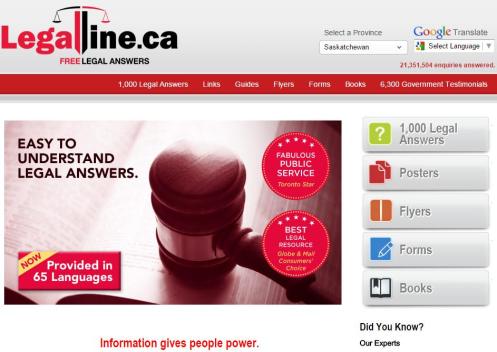
Legal Line describes its mission on its website,
Legal Line exists solely to help people make informed decisions. By knowing the law, you have the tools to help you work-through life’s real issues. Canadian lawyers and judges agree with us. With their help, and the support of 6,300 government and professional offices, our Website and 24-hour Telephone Information Line give you the legal answers you need.
Impressively, the website’s content is available in 65 different languages. The website is maintained by over 450 lawyers and judges, governed by a board of legal professionals, and supported by a variety of government organizations.
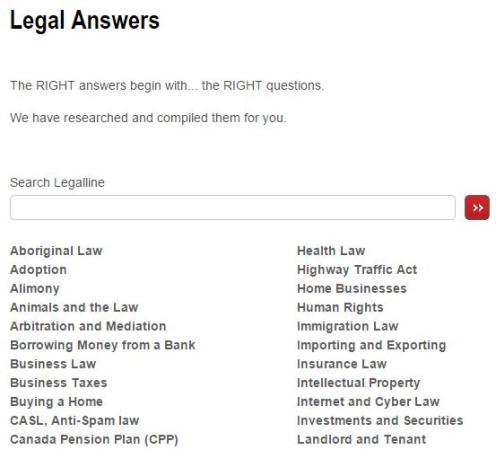
The most impressive feature of the website is the Legal Answers resource. Legal Answers is a searchable online encyclopedia that provides summaries of key areas of Canadian law. Topics covered range from adoption to cyberbullying to wrongful dismissal. Each legal topic is well written and easy to understand. A keyword search box and a browseable menu make this content highly accessible.
Legal Line is careful to make the distinction between legal information and legal advice. The website only provides information about law – none of the information on the website constitutes legal advice.
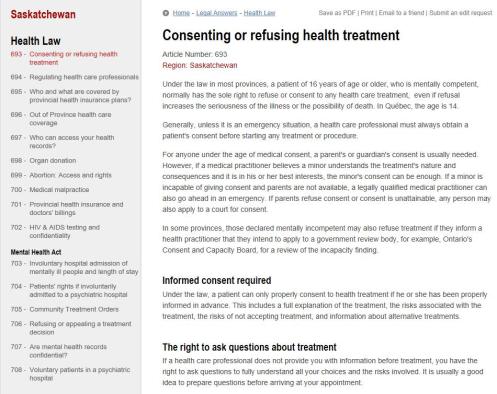
By striving to educate and empower everyday Canadians about the law, Legal Line is promoting better access to justice.
(Reposted from Legal Sourcery)
By Alan Kilpatrick
I recently created a series of tutorial videos to assist with searching the Saskatchewan Cases Database. You can watch the videos by clicking on the Library Tutorials button on the right side of the Law Society of Saskatchewan Library homepage. The videos demonstrate how to search the Saskatchewan Cases Database in a variety of ways:
• What is the Saskatchewan Cases Database? (1:46)
• Finding a Particular Case with the Saskatchewan Cases Database (2:32)
• Finding a Case of Unknown Name with the Saskatchewan Cases Database (2:39)
• Noting Up a Case with the Saskatchewan Cases Database (2:45)
• Noting Up a Statute with the Saskatchewan Cases Database (4:56)
What is the Saskatchewan Cases Database? (1) from Law Society of Sask Library on Vimeo.
Last month, the Public Legal Education Association of Saskatchewan (PLEA) launched a new website called Family Law Saskatchewan. Family Law Saskatchewan was created to help individuals facing family law issues navigate the Saskatchewan Courts without a lawyer. It should also be helpful to anyone who has questions about family law. The website is available at http://familylaw.plea.org/.
I had the privilege of attending the website launch in Saskatoon and am excited to share this resource with the Saskatchewan legal community.
The website provides background information on six common family law topics:
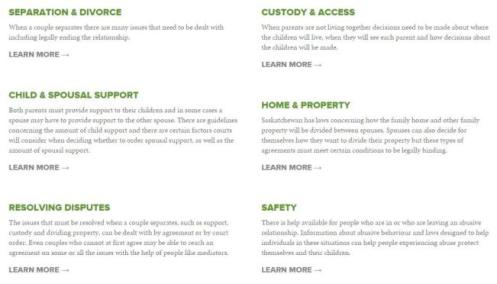
This information is written for members of the public without a legal background. Helpful FAQs are provided with each of the topics. It can help self-represented individuals decide what steps to take. Once a self-represented individual decides how to move forward with a family law issue, the website uses the Form Wizard to create the forms needed to begin a family law case. Family Law Saskatchewan explains,
By Alan Kilpatrick
Are you curious about the impact of new technology on the practice of law in Saskatchewan? Have tablets, the cloud, and tech gadgets changed how you practice law?
Last month, lawyers across Canada reacted with alarm to a sudden announcement from the Law Society of British Columbia (LSBC). Some asked whether the LSBC had just killed cloud computing for BC lawyers. Slaw, a popular legal blog, reported that Jan Linday, LSBC president, had seemingly announced that BC lawyers were banned from using cloud computing services located outside BC. Days of alarm and confusion followed. Jack Newton, a speaker on legal and technology issues, decried the prohibition and warned that it would turn BC into a “pre-cloud technological backwater.” The LSBC attempted to put an end to the confusion later that week by clarifying their position on the cloud. They explained that BC lawyers were not banned from using cloud services as long as they exercised appropriate due diligence.
What exactly is the cloud? PC Magazine explains, “In the simplest terms, cloud computing means storing and accessing data and programs over the Internet instead of your computer’s hard drive.” In the past, Mashable explains, “companies used to have to buy their own hardware equipment, the value of which depreciated over time. But now with the cloud, companies only have to pay for what they use. This model makes it easy to quickly scale use up or down.” Common cloud services include Google Drive, and Dropbox. Servers for these cloud services are often physically located outside Canada.
Many Canadian lawyers have raised valid concerns about security in the cloud and asked whether it is appropriate to store confidential and client information in the cloud. What do you think? Is the practice of law in Saskatchewan heading towards the cloud?
Please stop by the Law Society of Saskatchewan Library if you have any questions. We recently added a new book, Practice Law in the Cloud by David Whelan, to the library collection. It discusses the cloud and addresses the common concerns lawyers have raised.
Sources:
Fee, Jess, “The Beginners’ Guide to the Cloud” (2013) Mashable: Online.
Griffith, Eric, “What is Cloud Computing?” (2013) PC Magazine: Online.
Newton, Jack, “Did the LSBC Just Kill Cloud Computing for Lawyers in BC?” (2014) Slaw: Online.
Newton, Jack, “LSBC Clears Up Cloud of Confusion” (2014) Slaw: Online.
(Reposted from Legal Sourcery)
By Alan Kilpatrick
Last month, Louis Mirando, Chief Law Librarian at OsGoode Hall, wrote a blog post regarding the future of Canadian legal citation on Slaw. The post is boldly titled Legal Citation: Beyond the McGill Guide.
You are likely familiar with the McGill Guide. The McGill Guide, officially known as the Canadian Guide to Uniform Legal Citation, is a popular citation guide for Canadian legal materials. The guide is published by Carswell and edited by the McGill Law Journal. In its eighth edition, the guide is used by many law journals and several courts.
In his recent Slaw post, Mirando is critical of the McGill Guide and suggests two basic problems exist with the guide: the guide is written by students and published by Carswell. Students may not yet possess the expertise to create a citation guide for practitioners. Carswell, as a publisher, is concerned with an income stream that can only be maintained by price increases and frequent new editions. Mirando suggests in his post that these new editions “are unnecessary and unjustified, lightly sprinkled with gratuitous and often ill-considered changes that fail to advance citation practice, confuse and sow uncertainty and even disagreement among even seasoned legal writers, editors and instructors, and generally make citation practice even less uniform and uniformity more difficult to realize.”
By Alan Kilpatrick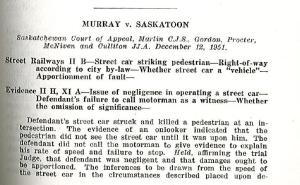
Have you heard about the notorious Saskatoon trolley case?
Late on the summer evening of July 20th, 1949, a pedestrian named James Murray crossed the Saskatoon intersection of Second Avenue and 20th Street East. While crossing from west to east on a marked crosswalk, Murray was abruptly struck by a south bound street car. He soon died from the injuries sustained from the impact. The street car, operated by the Saskatoon Street Railway, was driven by Steward Maxfield.
An eye witness saw Murray’s body thrown backward as a result of the impact. Another witness exclaimed,
“Well he did not seem to see the street car coming, he was walking rapidly; I take it he was trying to catch the bus and when he got in front of the street car he turned – seemed to notice it and it just – and it hit him on the left side.”
 Murray’s widow brought an action against the city and alleged “that she and [her] children were dependent upon the deceased for support.” It was purported that Stewart Maxwell was negligent for not maintaining a satisfactory look out, for driving the trolley too fast, and for failing to sound the warning gong. Maxwell denied the claims and asserted Murray was negligent for failing to look before walking into a busy city intersection.
The plaintiff’s counsel rapidly admitted that the deceased Murray was guilty of contributory negligence for failing to look before walking forward into the intersection. “The question for determination by the learned trial Judge was whether or not the defendant, by its employee, the operator of the south-bound street car, was also guilty of negligence.” Surprisingly, Maxfield was not called forward as a witness and his counsel simply rested their case on the evidence already put forward by the plaintiff. They asserted there was no evidence of Maxfield’s negligence while in operation of the street car.
Consequently, the Judge remarked,
“There are, in my opinion, no facts in the evidence which warrant an inference that the deceased, by his conduct, created an emergency which prevented the motorman from taking steps to avoid him. This is a matter of defence which might have been dealt with by the motorman had he been called…During the course of the argument considerable attention was devoted to the question of the effect which should be given to the action of a party in not calling a witness who could give evidence which it was in his power to give and by which the facts might be elucidated.”
Murray v. Saskatoon, 4 WWR (NS) 234, also known as the Saskatoon Trolley Case, has been cited frequently in recent years for its illuminative discussion of adverse inference.
(Reposted from Legal Sourcery)
By Alan Kilpatrick
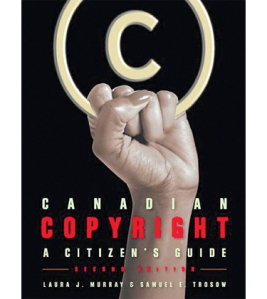
Does copyright law baffle you? Does anyone understand what it means when they click I agree? Do you have to be a detective to figure out who the copyright owner is?
Canadian Copyright: A Citizen’s Guide lays out the foundations of basic copyright law and discusses practical applications of copyright in a variety of contexts. Simply put, this book is for everyone. “Whether you are a parent, artist, business person, blogger, teacher, student, or music fan, questions about copyright have popped into your head or landed in your lap.” The authors address the momentous changes that rocked the world of Canadian copyright in 2012, including the Copyright Modernization Act (SC 2012, c 20) and five major Supreme Court of Canada decisions. Written in a comprehensible style, the second edition of this book was long overdue and eagerly anticipated by many.
The book is skillfully arranged into four parts: ideas, law, practice, and contexts. The book begins with a brief discussion of the philosophy and history of copyright law in part one and then proceeds to copyright scope, owner’s rights, and user’s rights in part two. Civil and criminal infringements are touched upon as well. Part three of the book “covers more specific terrain, considering the issues that copyright presents for people” who work in specific fields like music, digital media, or education. The book concludes with a discussion of copyright counterparts and the future of copyright law in Canada.
Both authors bring a wealth of diverse knowledge and authority to this subject. Samuel E. Trosow, a former professor of mine, is an associate professor at the University of Western Ontario, where he teaches in the Faculty of Law and the Faculty of Information and Media Studies. Laura J. Murray is an associate professor at Queen’s University, where she teaches English and Cultural Studies.
Canadian Copyright: A Citizen’s Guide is recommended without reservation.
(Reposted from Legal Sourcery)
By Alan Kilpatrick
Copyright is a hot topic in Canada. Discussions on copyright often lead to contention and controversy. A basic understanding of copyright can help ensure fair and equitable access to law, justice, and information. Over the past several weeks, we have explored copyright balance and copyright owner rights. This week, we are going to discuss an important user right.
As with copyright owners, copyright users are also granted a variety of rights under the Copyright Act. The most important user right to know about is called fair dealing.
Fair dealing is the right, when fair and reasonable, to copy a substantial portion of a copyrighted work without permission from, or payment to, the copyright owner. Fair dealing is briefly expressed in section 29, 29.1, and 29.2 of the Act.
Fair dealing for the purpose of research, private study, education, parody, satire, criticism, review, and news reporting does not infringe copyright.
At paragraph 48 of CCH Canadian Ltd. v. Law Society of Upper Canada, 2004 SCC 13, the Supreme Court of Canada (SCC) described fair dealing as:
…an integral part of the Copyright Act…any act falling within the fair dealing exception will not be an infringement of copyright.
Fair dealing is an exception to copyright infringement. It is also crucial to maintaining proper copyright balance between owner rights and user rights. At paragraph 48 the SCC goes on to say:
The fair dealing exception…is a user’s right. In order to maintain the proper balance between the rights of a copyright owner and users’ interests, it must not be interpreted restrictively.
To maintain balance, we can think of user rights as a limit on owner rights. The Copyright Act does not define exactly what fair dealing is or the amount of copying considered fair. To help copyright users assess whether their copying falls within the fair dealing exception, the SCC established a fair dealing test involving six criteria at paragraph 60 of the same judgment:
…the purpose of the dealing, the character of the dealing, the amount of the dealing, the nature of the work, available alternatives to the dealing and the effect of the dealing on the work are all factors that could help determine whether or not a dealing is fair. These factors may be more or less relevant to assessing the fairness of a dealing…In some contexts, there may be factors other than those listed here that may help a court decide whether the dealing was fair.
Next time, we will explore these six criteria: purpose, character, amount, alternatives, nature, and effect. The Canadian Association of University Teachers has published an excellent description of the fair dealing test here.
(Reposted from Legal Sourcery)

 LibraryCanuck