By Alan Kilpatrick
 Did you know that the Law Society Library in Regina holds the unique distinction of being the first computerized law library in North America? According to a Leader Post article from February 20th, 1980, which featured an interview with the library’s director, Douglass MacEllven, the Law Society of Saskatchewan Library was the first in North America to have a computer system.
While the Law Society Library languished for much of the 1970s without any professional staff, the 1980s saw the Law Society Library boldly enter the computer age under the MacEllven’s direction. With access to Quicklaw and a province wide network of fax machines, the library was able to complete instantaneous research and send detailed materials to rural lawyers, “by telecopier using the telephone wire within a few hours.”
Douglass MacEllven served as director from 1977 to 1988. He oversaw the computerized modernization of the Law Society Library and was awarded honorary lifetime membership of the Law Society in 1988.
References
A Century of Integrity: The Law Society of Saskatchewan 1907 to 2007
Computerized law library in Regina is first in North America
By Alan Kilpatrick
Alan Kilpatrick, Reference Librarian with the Law Society Library in Regina, will be presenting an access to justice themed webinar for the Provincial and Territorial Library Associations of Canada Education Institute on October 4th, 2016:
Legal Resources for Librarians
Having access to the law gives members of our society the tools needed to make informed decisions. Unfortunately, access to legal services has become increasingly unaffordable and inaccessible in Canada. Libraries can play an important role in improving access to justice.
A 2010 survey conducted by Courthouse Libraries BC estimated that public libraries in British Columbia receive about 35,000 legal reference questions from the public every year. Libraries are a natural place to connect with members of the public who have legal information needs. In this webinar, you’ll learn about searching case law, legislation, and legal resources, including CanLII and the National Self-Represented Litigants Project.
Tuesday, October 4th, 2016 @ 12 pm
One-hour webinar
$45 for members
$55 for non-members
Presenter: Alan Kilpatrick
The Education Institute is a continuing education initiative developed by The Partnership of Provincial and Territorial Library Associations of Canada for library workers across Canada.
By Alan Kilpatrick
I am excited to let you know about a major development with the Best Guide to Canadian Legal Research. As you may know, the guide is a popular free online legal research guide that has been a fixture of the internet for the last fifteen years.
The online guide was created and maintained for the past decade and a half by Catherine Best, an experienced research lawyer, author, and CanLII board member. Catherine retired from law in 2015.
CanLII recently announced that it will be assuming editorship of the guide now that Catherine has retired. It will also be adopted as CanLII’s official legal research guide.
Consequently, the guide has been rebranded as The Canadian Legal Research and Writing Guide and will now be available at legalresearch.org.
You can learn more from CanLII’s official news announcement.
By Alan Kilpatrick
Erica Anderson, Research Librarian at the Ontario Legislative Library, and Susan Barker, Reference Librarian at the Bora Laskin Law Library, wrote an excellent article exploring legislative intent research for the Canadian Parliamentary Review last September: Cinderella at the Ball: Legislative Intent in Canadian Courts.
Legislative intent research, Anderson and Barker explain, involves finding the intent of the Legislature or Parliament behind a particular statute. Today, this is a common task for lawyers that has real consequences in the court room. The outcome of a case may rest on how a judge understands legislative intent. An aspect of Driedger’s Rule of Statutory Interpretation, the most common toolkit used to interpret statutes in Canada, involves finding legislative intent. How can legislative intent in Saskatchewan be researched?
The best resource for researching legislative intent in Saskatchewan is the Hansard, also known as the Debates and Proceedings of the Legislative Assembly of Saskatchewan. Hansard “is an essentially verbatim report of the debates that take place in the Assembly and its committees.” The debates for a particular date can be searched through a Legislative Calendar, Committee Meeting Archive, Subject Index, or a Speaker Index.
Reché McKeague, a feature blogger for Legal Sourcery, has created an outstanding tutorial describing How to search Saskatchewan’s Hansard.
By Alan Kilpatrick
In September 2015, I presented a webinar on LegalTrac for Saskatchewan public library staff. LegalTrac is an online journal article index, providing some full-text coverage of law reviews, journals, and newspapers from American, Canadian, and European legal sources.
The record webinar can be viewed for free on the LibraryToolshed, an initiative of libraries in Alberta, Saskatchewan, and British Columbia and a place to share library training resources. I was gratified to learn earlier this week that my LegalTrac webinar was one of the most heavily visited pages in the Library Toolshed in Spring 2016. I am pleased that so many library staff have found this webinar valuable and useful.
Libraries are playing an important role in improving access to justice, and this webinar was one of the ways the Law Society Library contributes to the ongoing efforts. A 2010 survey conducted by Courthouse Libraries BC estimated that public libraries in British Columbia receive about 35,000 legal reference questions from the public every year, making libraries a natural place to connect with members of the public who have legal information needs.
My hope is that by participating in these collaborative initiatives, public librarians will come away with greater confidence to assist library patrons seeking legal information and improve access to justice in the process.
By Alan Kilpatrick
 The Legal Sourcery team would like to take a moment to give a shout out to a new legal resources blog, Robeside Assistance. Robeside Assistance is the relaunch and rebranding of the County of Carleton Law Association (CCLA) Library’s existing blog. It is written and maintained by the CCLA’s phenomenal library staff: Jennifer Walker, Brenda Lauritzen, and Amanda Elliott.
Robeside Assistance features practical legal research tips and tricks, the lowdown on the latest legal resources, and reliable compilations of recently published Ottawa decisions. Here are a few of the great research tips you will find featured on Robeside Assistance:
•How to Find Unreported Decisions
•Research Tip: American Case Law
We have to hand it to them, coming up with a great blog name can be difficult. Robeside Assistance takes the cake when it comes to blog names.
We look forward to following Robeside Assistance. It can be found online at robesideassistance.ca.
By Alan Kilpatrick
 The 2016 Canadian Association of Law Libraries (CALL) Conference took place in Vancouver from May 15 to May 18. This year’s theme was Competence, Challenges, and Connections. The conference is an outstanding opportunity for law librarians and legal information professionals to improve professional and specialized skills, network with colleagues and vendors, identify emerging legal information trends, and evaluate new legal resources.
I presented a lightning talk on coordinating social media for CALL. A lightning talk is a short presentation lasting no more than seven minutes. Here is the session description for the talk I presented:
Coordinating CALL’s Social Media Channels
CALL is a lively hub of information for law librarians. How can you keep track of the multitude of events, webinars, scholarships, and networking opportunities taking place through CALL? If you’re a member of a committee, how do you effectively communicate and build relationships with members of this nationwide association? If you find yourself asking these questions, look no further than CALL’s social media channels.
I was appointed as CALL’s Social Media Coordinator (SMC) in 2015 to coordinate the association’s social media more systematically. On these channels, you will discover daily posts with information relevant to law librarians, CALL members, and non-members in related fields. Following CALL on social media makes it easier to keep track of the variety of professional opportunities available through the association.
During this talk, you will find out about CALL’s new SMC position, and some of the practical lessons I have learned since taking on this new position.
You can find the full text of the lightning talk and the accompanying PowerPoint presentation online here.
By Alan Kilpatrick

Photo Credit: Pahkisimon Nuye?áh Library System
The annual Saskatchewan Libraries Association Conference was held in Saskatoon from May 5 to May 7. The theme for this year’s conference was Cooperation: Saskatchewan Style. The conference featured a variety of instructive sessions and provided an opportunity for library workers in the province to network.
As the Law Society’s Reference Librarian in Regina, I presented a session on how libraries can help improve the public’s access to justice. Here is the session description:
Fence at the Top of the Cliff: Legal Resources for Librarians
Access to justice has become a major issue in Canada. Legal services have become increasingly unaffordable and inaccessible. Libraries can play an important role in improving access to justice. A 2010 survey conducted by Courthouse Libraries BC estimated that public libraries in BC receive about 35,000 legal questions every year. As such, libraries are the natural place to connect with members of the public who have legal information needs.
Join Alan Kilpatrick, Reference Librarian at Law Society of Saskatchewan Library, for this session exploring basic legal resources. Participants will learn about key legal resources and the organizations in Saskatchewan that provide free legal advice. Importantly, participants will leave this session with greater confidence to assist library patrons seeking legal information.
You can find the full presentation here. The Access to Civil and Family Justice: A Roadmap for Change report identified a need for intermediaries to help members of the public locate credible online legal information. While there is more legal information online than ever before, it is less clear what legal information is credible.
Librarians are these intermediaries. We have the specialized skills to provide accurate referrals to organizations that provide legal assistance and to locate credible legal information.
By Alan Kilpatrick
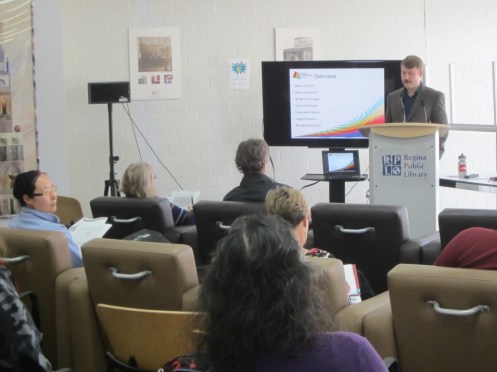
On April 14, the Regina Public Library held its first annual Legal Resource Fair in recognition of the Canadian Bar Association’s Law Day.
During the bustling and lively all-day fair, members of the public learned about their legal rights and the wide variety of free legal service providers in Regina. Community organizations helped make the fair a real success by hosting interesting workshops throughout the day. Lawyers from the Family Law Information Centre and Pro Bono Law Saskatchewan provided free drop-in sessions for members of the public requiring legal assistance.
Alan Kilpatrick, the Law Society’s Reference Librarian in Regina, hosted a well-attended workshop on CanLII and Basic Legal Research Skills for the Public.
The Law Society of Saskatchewan Library was excited to contribute to the fair and looks forward to participating again next year. Thank you to the Regina Public Library for organizing and hosting this event.
This is a great example of how libraries and librarians are stepping up, working together, and developing real solutions to the access to justice crisis in Canada.
The Saskatoon Public Library also held a Legal Resource Fair on April 17.
Here is a picture from the Regina Public Library Legal Resource Fair:
By Alan Kilpatrick

In honour of the Canadian Bar Association’s Law Day, the Regina Public Library is cordially hosting a Legal Resources Fair on April 14th from 12 – 8 pm at the Central Library.
Drop in between these hours to learn about your legal rights and to connect with community and legal service providers in Regina. Free drop-in sessions will be available with helpful lawyers from Regina’s Family Law Information Centre.
Volunteer lawyers with Pro Bono Law will be offering up to 30 minutes of free legal advice. All appointments with Pro Bono Law must be pre-booked.
Community organizations and lawyers will be participating in the all-day fair by hosting workshops:
• Pro Bono Law Saskatchewan Legal Assistance Clinic
• Law Society of Saskatchewan Library
• The Police and Crisis Team
• The French Legal Information Centre
• Christina Skibinsky, Official Representative, Mental Health Services Act
• Wayne Bernakevitch, The Essentials Of Real Estate Transactions
The Law Society of Saskatchewan Library is excited to participate in the event and to connect with members of the public in Regina. Alan Kilpatrick, the Reference Librarian in Regina, will be hosting a one hour session on CanLII and Basic Legal Research Skills for the Public from 3 – 4 pm. CanLII is a phenomenal website that provides free access to Canadian law. On CanLII, you will find more than one million court decisions and thousands of statutes.
Do you need to learn how to conduct your own legal research? Are you just curious about Canadian law? Don’t miss this exciting session with the Law Society of Saskatchewan Library!
We look forward to seeing you there!

 LibraryCanuck