I was asked to create a short video summary of the poster that Marni and I recently presented at the 2013 OLA Super Conference in Toronto, “Copyright and Canadian Academic Libraries.” The video was created for inclusion in the super conference virtual conference poster session offerings. While Marni physically presented the poster in person at the conference, I presented virtually through Skype from India. I am currently on a library internship with the Hippocampus Reading Foundation in Bangalore, India.
Copyright and Canadian Academic Libraries
“A current review of the state of copyright in Canadian Academic Libraries will be presented. In recent years, copyright has become a major issue for universities and colleges in Canada. Many institutions have had to confront copyright issues and make serious decisions about the future of copyright in their libraries. Successful information literacy and instruction is dependent on librarians’ ability to access and share information. Alternatives to licensing and publishing will also be discussed in relation to copyright. This poster will review and present copyright issues from 2010 to present.”
Marni Harrington and I recently presented a poster at the 2013 OLA Super Conference entitled “Copyright and Canadian Academic Libraries.” Please find a copy of our poster available at the link below.
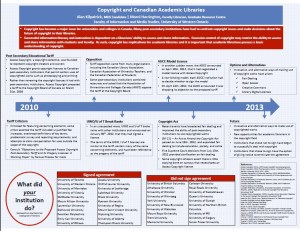
Alan G. Kilpatrick, University of Western Ontario
Marni R. Harrington, University of Western Ontario
Abstract
A current review of the state of copyright in Canadian Academic Libraries will be presented. In recent years, copyright has become a major issue for universities and colleges in Canada. Many institutions have had to confront copyright issues and make serious decisions about the future of copyright in their libraries. Successful information literacy and instruction is dependent on librarians’ ability to access and share information. Alternatives to licensing and publishing will also be discussed in relation to copyright. This poster will review and present copyright issues from 2010 to present.
Suggested Citation
Alan G. Kilpatrick and Marni R. Harrington. “Copyright and Canadian Academic Libraries” OLA Super Conference 2013. Toronto, ON. Jan. 2013.
Available At
http://works.bepress.com/marni_harrington/12
Please feel free to download a copy of our poster for your own use or to distribute it among your colleagues.
From January to April 2013, I have the privilege of working with the Hippocampus Reading Foundation in Bangalore, India as a library research intern.
The Hippocampus Reading Foundation, founded in 2004, is an organization that works to inspire and encourage children from disadvantaged communities in India to read. Hippocampus does this by developing partnerships with local community groups and organizations, setting up active libraries, and through the GROW By Reading program.

Along with another Master of Library and Information Science student from the University of Western Ontario, I will be working to develop and execute a marketing strategy to help Hippocampus reach out to a greater number of low cost schools and not for profits to libraries in India. My adventures will be posted weekly to another blog called “Out of the Stacks: An MLIS India Internship.”
I am excited to learn about international librarianship and look forward to sharing all of my library adventures with you!
Cheers,
Alan Kilpatrick
In the Fall 2012 term of library school, I presented a lecture entitled “Copyright in Canadian Post-Secondary Institutions,” for my LIS 9130 Information Policy course at the University of Western Ontario. In this presentation, I illustrated an overview of academic copyright in Canada, addressed some recent copyright events, and considered the future of academic copyright.
Some of the issues I addressed in the presentation included:
•Copyright Context 2012
•Copyright Collectives
•Post-Secondary Educational Tariff
•UWO/U of T Agreements and the AUCC Model License
•Motivation for Signing
•Future of Academic Copyright
Please feel free to download a copy of the presentation for your own use or to distribute it among your colleagues here.
Cheers,
Alan Kilpatrick
In Net Neutrality in Canada and what it Means for Libraries Alex Guindon and Danielle Dennie explore the debate surrounding which social functions should be served by the internet. They consider whether the internet is best treated as a public good promoting universal access for all citizens or whether the internet should be handled by telecommunication companies as a private commodity.
In her article, Canada Must Make Broadband Infrastructure a Priority, Maggie Matear argues that the internet in Canada, like telephone service and public utilities, should be treated as an essential service with the idea of universal access.
When considering universal access and the internet as an essential service, it is helpful to explore the common carrier concept. In common law tradition, telephone companies, public utilities, and transportation companies share a common duty and an imposed obligation to serve. This obligation is imposed due to the essential nature of the service provided. Given the importance of telephone service to the nation, telephone companies in Canada have long been treated as common carriers and imposed with a duty to serve Canadian citizens. Telephone service has been considered particularly vital to remote and rural areas in Canada.
Many in Canada, including Matear, Birdsall, and Middleton, assert that the internet is an essential service and argue that internet providers in Canada should be treated as common carriers subject to this duty to serve.
In his 2012 article, Telecommunications Carriers and the Duty to Serve, Michael Ryan presents a thorough overview of universal access and common carriers. Ryan explains that a recent 2010 CRTC proceeding, Proceedings to Review Basic Telecommunications Services and Other Matters, explored whether broadband internet should be subject to an imposed service obligation.
This CRTC proceeding concluded that internet companies were not common carriers and that internet service did not fall within this imposed duty to serve.
Ultimately, the debate regarding whether the internet is as an essential service is far from over.
During the Summer 2012 term of library school, I created a Camtasia tutorial for LIS 9713 “Internet Broadcasting”. Camtasia is a great instruction and information literacy tool for librarians. The video editing program is easy to use and available for a free thirty day download . Check out the TechSmith website for a comprehensive tutorial here.
Please find the tutorial on youtube: http://www.youtube.com/watch?v=TAEvGIclJkg
If you missed Access Copyright: What does it mean for Western? A Librarian’s Guide when it was first presented this past summer, I will be presenting for the second time this week.
“Western was one of the first universities to sign an Access Copyright Agreement. Alan Kilpatrick, an MLIS Candidate, will present the details of this agreement and discuss how it affects libraries and librarians at Western. This is a great opportunity for students interested in academic librarianship and practising academic librarians to discuss the implications of this agreement.”
Here are the presentation details:
Thursday October 11th
12pm – 1pm
University of Western Ontario
North Campus Building (NCB) Room 293
Please feel free to download a copy of the presentation for your own use or to distribute it among your colleagues:
Fair dealing is the one of the most important copyright user rights in Canada . It is crucial librarians, educators, and all copyright users thoroughly familiarize themselves with the fair dealing user right.
Fair dealing is the right, when fair and reasonable, to copy and reproduce a substantial portion of a copyrighted work without any permission from, or payment to, the copyright owner. While the Copyright Act of Canada says little about fair dealing and does not define what copying would be considered fair, this user right has been clarified over time through a number influential Supreme Court decisions. Described as an integral part of the Copyright Act by the court, fair dealing plays a critical role in ensuring balance between the interests of copyright owners and copyright users.
To help copyright users assess whether their copying falls within fair dealing, the Supreme Court established a two-part test, involving six criteria. In establishing this fair dealing test, the Supreme Court articulated that fair dealing is highly flexible doctrine open to the individual interpretation of all copyright users and that it must always be assessed on a case by case basis. The court clarified that the past copying practices and actions of copyright users help shape what is considered fair under the law.
Some copyright users might prefer that fair dealing be a static cut and dry set of rules in which the question of whether one’s copying is fair is concretely defined and easily ascertainable. It would certainly be easier, less burdensome, and less time consuming for copyright users if this were the case, as opposed to a fair dealing doctrine largely open to individual interpretation and assessed on a case by case basis.
In his article in Geist’s latest reader, “Bill C-32 and the Educational Sector: Overcoming Impediments to Fair Dealing,” Sam Trosow describes a host of special educational exceptions to copyright owner rights featured in Bill C-32. The primary issue with these special education exceptions is that they are essentially static cut and dry rules. Ultimately, they are narrow, restricted, complex, and challenging to understand and use. Being static and narrow, these special exceptions will never be able to adequately meet the needs of the educational community as they will never be able to keep up with the rapid pace of technological development. As technology moves ahead, the needs of the educational community change quickly in response. Copyright doctrine that does move forward at the same pace is simply inadequate.
It is precisely this reason that fair dealing is such a crucial copyright user right. By being flexible and open to individual interpretation, fair dealing can be immediately responsive to technological change as well as our changing needs regarding access to information. As such, fair dealing can meet the needs of the educational community as well as the library community and all copyright users. In a world of rapid copyright change, static sets of rules like the special education exceptions are not the answer. Flexible doctrines like the fair dealing user are the answer and the path towards continued fair and reasonable access to information.
Consequently, most education and library special interest groups in the post-CCH era have wisely dropped their support of special education exceptions in the face of broad fair dealing rights.
Carys Craig, in his article in Geist’s reader, “Locking Out Lawful Users: Fair Dealing and Anti-Circumvention in Bill C-32”, highlights some perceived inadequacies with the fair dealing user right. Primarily, he argues that for fair dealing to become a viable user right, it needs to become more like the open ended fair use defence in the United States. Since Craig wrote this article for Geist’s 2011 reader however, several radical changes, equal in influence to CCH, have rocked the world of Canadian copyright.
In June 2012, Bill C-11, the new copyright act, added the much desired categories education, parody, and satire to fair dealing. While the new copyright act fell short of adding the words “such as” to fair dealing, a series of five Supreme Court decisions from the following month in July significantly broadened and expanded the allowable categories of fair dealing. These decisions, Alberta (Education) v. Access Copyright in particular, expanded the scope of the fair dealing categories to such a degree that copyright scholar Michael Geist asked whether Canadian fair dealing had “effectively shifted” to the more open ended American fair use doctrine. These transformational events have eliminated most of the inadequacies that may have existed in fair dealing prior to June and July 2012.
Given the expanded, broadened, and clarified fair dealing doctrine that emerged out of June and July 2012, I argue there is nothing holding educators, librarians, and copyright users back from making full use of their fair dealing rights under copyright law.
In the face of copyright chill, it is important for educators, librarians, and copyright users to educate themselves about fair dealing and to promote fair dealing. Such education and promotion will continue to ensure a balanced copyright system in which access to information remains fair and reasonable for all.
Alan Kilpatrick
Do you need to make sense of the dramatic changes that have taken place in the world of Canadian copyright? Check out this handy list of resources, links, and blogs I developed! Download a copy my copyright resources list here!
Copyright Resources
•Access Copyright. (2012, January). UWO Access Copyright Licensing Agreement. Retrieved from http://plglondon.files.wordpress.com/2012/03/ac-uwo1.pdf
•Canadian Association of University Teachers. (2012, February). BACKGROUNDER: UWO and U of T Agreements with Access Copyright. Retrieved from http://www.caut.ca/uploads/Backgrounder_UTUWO_Agreements.pdf
•Canadian Association of University Teachers. (2011, April). CAUT Guidelines for the Use of Copyrighted Material. Retrieved from http://www.caut.ca/uploads/Copyright_guidelines.pdf
•Canadian Association of University Teachers. (2008, December). CAUT Intellectual Property Advisory: Fair Dealing. Retrieved from http://www.caut.ca/uploads/IP-Advisory3-en.pdf
•Geist, M. (Ed.). (2010). From “Radical Extremism” to “Balanced Copyright”: Canadian Copyright and the Digital Agenda. Toronto: Irwin Law.
•Murray, L.J. & Trosow, S.E. (2007). Canadian Copyright: A Citizen’s Guide. Toronto: Between the Lines.
•Parliament of Canada. (2012, June). Bill C-11: An Act to Amend the Copyright Act. Retrieved from http://www.parl.gc.ca/HousePublications/Publication.aspx?Docid=5144516&file=4
•Queen’s University Library. (2008). Fair Dealing Evaluator. Retrieved from http://library.queensu.ca/fairdealing/index.php
Copyright Blogs
•Geist, M. (2012). Michael Geist – Blog. Retrieved from http://www.michaelgeist.ca/
•Katz, A. (2012). Copyright: Ariel Katz. Retrieved from http://arielkatz.org/archives/category/blog/copyright
•Knopf, H. (2012). Excess Copyright. Retrieved from http://excesscopyright.blogspot.ca/
•Trosow, S. (2012). Sam Trosow. Retrieved from http://samtrosow.wordpress.com/
“Access Copyright: What does it mean for Western? A Librarian’s Guide” has been accepted into the Scholarship @ Western website. The presentation and accompanying handouts can be accessed here:

 LibraryCanuck